
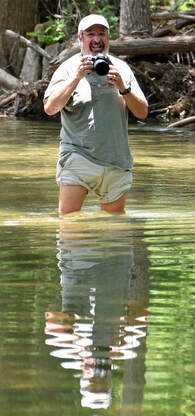
Larry Garmezy
Bending Light - A Great Adventure at Archway since 2011
My photographs chronicle what I find visually and intellectually intriguing in the natural world. As a geologist, understanding the physical processes that create patterns in nature allows me to capture unusual impressions and abstractions of the visual landscape. The common thread running through much of my work is the distortion of light, color, and shape created either by ripples in a spring, surface tension around a floating leaf, or the defects in a 400-year-old pane of glass. And, of course, when a beautiful landscape is found, I' strive to capture the serenity of the scene.
Natural Springs
Photographing the same natural springs for many years, I find that like snowflakes, no two images are alike. The constant is the incredible interplay of light with surface ripples and the palette of colors from plants beneath the surface. Varying the time of exposure creates a further abstraction of the waterscape. This fluid environment is ideal for the photographic art form. While the human eye can see the motion created by the upwelling of water, it takes a mechanical shutter and a telephoto lens to “freeze” the scene, revealing the composition’s unique beauty.
Surface Tension
Over the years when fall leaves make a mess of my yard and pool, I’ve noticed the amazing shadows on the bottom of the pool created by the lensing effects caused by surface tension warping the surface of the water around the edges of floating leaves. During COVID, while we were all stuck in our backyards, I figured out a way of capturing this effect without the background distraction of a fifty-year-old pool. A background of leftover tile placed in the pool made these unusual shadows pop.
My photographs chronicle what I find visually and intellectually intriguing in the natural world. As a geologist, understanding the physical processes that create patterns in nature allows me to capture unusual impressions and abstractions of the visual landscape. The common thread running through much of my work is the distortion of light, color, and shape created either by ripples in a spring, surface tension around a floating leaf, or the defects in a 400-year-old pane of glass. And, of course, when a beautiful landscape is found, I' strive to capture the serenity of the scene.
Natural Springs
Photographing the same natural springs for many years, I find that like snowflakes, no two images are alike. The constant is the incredible interplay of light with surface ripples and the palette of colors from plants beneath the surface. Varying the time of exposure creates a further abstraction of the waterscape. This fluid environment is ideal for the photographic art form. While the human eye can see the motion created by the upwelling of water, it takes a mechanical shutter and a telephoto lens to “freeze” the scene, revealing the composition’s unique beauty.
Surface Tension
Over the years when fall leaves make a mess of my yard and pool, I’ve noticed the amazing shadows on the bottom of the pool created by the lensing effects caused by surface tension warping the surface of the water around the edges of floating leaves. During COVID, while we were all stuck in our backyards, I figured out a way of capturing this effect without the background distraction of a fifty-year-old pool. A background of leftover tile placed in the pool made these unusual shadows pop.
400-Year-Old Glass
Recently I expanded my interest in visual distortion, this time using antique hand-blown glass to provide a new perspective. The project began over ten years ago in The Netherlands when I noticed the fractured and faceted appearance of a local carnival as seen through the 17th-century windows of the Delft City Hall. Inspired, I began capturing more images through original glass windows in other European buildings from the 16th and 17th centuries. This exploration continued in Houston with “restoration” glass manufactured in Germany using 400-year-old methods. Designing and building a system for placing this glass between my subjects and the camera lens allowed me to deconstruct still lifes, portraits, musical instruments, Houston cityscapes, political landmarks and more.
During this exploration, I’ve wondered if the “faceting” I’ve observed looking through centuries-old windows could have influenced the artistic development of the cubism movement (1907 – 1918). What I’ve seen in the 2020s was certainly observable by the artists of the early 1900s looking through similar windows. The origin of this “faceting” in cubist paintings remains a mystery to art historians.
Recently I expanded my interest in visual distortion, this time using antique hand-blown glass to provide a new perspective. The project began over ten years ago in The Netherlands when I noticed the fractured and faceted appearance of a local carnival as seen through the 17th-century windows of the Delft City Hall. Inspired, I began capturing more images through original glass windows in other European buildings from the 16th and 17th centuries. This exploration continued in Houston with “restoration” glass manufactured in Germany using 400-year-old methods. Designing and building a system for placing this glass between my subjects and the camera lens allowed me to deconstruct still lifes, portraits, musical instruments, Houston cityscapes, political landmarks and more.
During this exploration, I’ve wondered if the “faceting” I’ve observed looking through centuries-old windows could have influenced the artistic development of the cubism movement (1907 – 1918). What I’ve seen in the 2020s was certainly observable by the artists of the early 1900s looking through similar windows. The origin of this “faceting” in cubist paintings remains a mystery to art historians.
If you have any questions or want to discuss any of my work contact me at... [email protected] or get more backstories about the work on my website.
Most of my work is printed with archival ink on somerset velvet art paper at either 18” x 24”, 11" x 14", 12" x 12",or 24” x 30”, but some are significantly larger. Custom sizes are available, and all works are limited signed editions of 25 regardless of size.
See more of my work in the store.
Most of my work is printed with archival ink on somerset velvet art paper at either 18” x 24”, 11" x 14", 12" x 12",or 24” x 30”, but some are significantly larger. Custom sizes are available, and all works are limited signed editions of 25 regardless of size.
See more of my work in the store.